
Lift heavy. Run far.
Two disciplines. One body.
HybridX is an AI training planner that fits both into one week.
Start free14 days free · no card
Or get your hybrid score firstMost training plans assume you'll do every session. You won't.
I certainly don't. Some weeks I travel. Some weeks a kid gets sick, work runs long, or I wake up flat and Tuesday's intervals just aren't happening. For a long time my own app handled this badly. It left the missed session sitting there, struck through, and quietly let the rest of the week drift out of balance. The plan was honest on Monday and useless by Thursday.
So over the last few weeks I rebuilt that part of HybridX. Not the training science — the part where the plan meets real life. Here's what changed, and why.
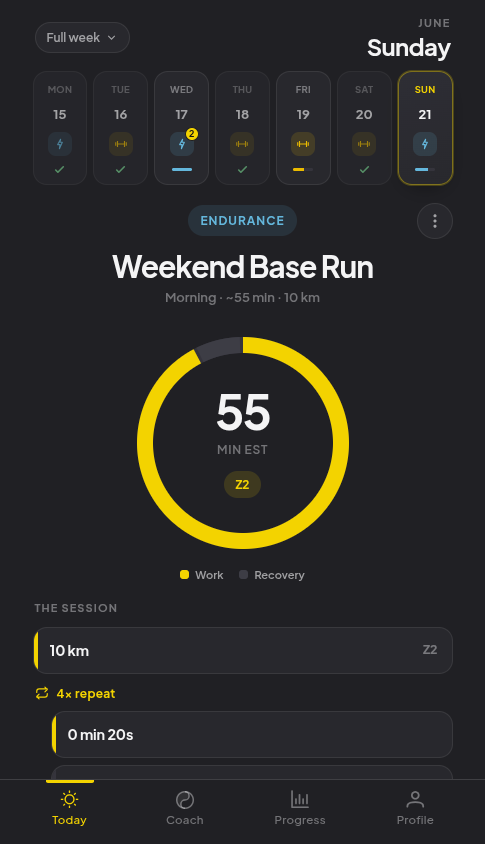
The home screen used to show the whole week up front: a grid, every day, every session. It looked organized. It also made you do the sorting — which one is today, what's already done, what's next.
Now it opens on one thing: today's session. The lift or the run, its structure, and an effort ring that shows where the work actually sits. For a run, that's warm-up, the hard middle, and cool-down. For a strength day, it's one arc per lift, colored by body region, so a lower day and an upper day look different at a glance. The rest of the week is one swipe away when you want it. Most days you don't.
Less to read. One decision: start the session.
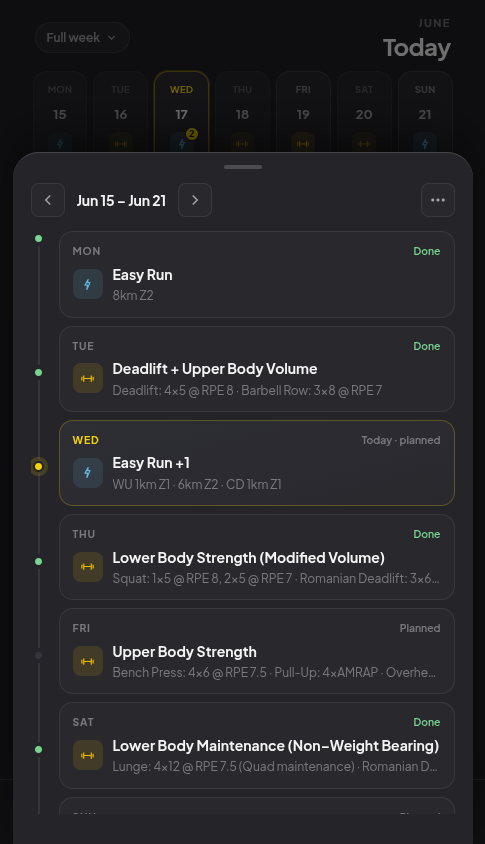
This is the big one.
Old behavior: you miss Wednesday's strength, and nothing happens. The week pretends it didn't. Every session after it is now built on a Wednesday that never occurred — and the load math is quietly wrong for the rest of the week.
New behavior: skip a session, or just let one roll past at the end of the day, and HybridX asks one question — adjust the rest of your week? Tap Adjust it and it re-plans only the days you haven't done yet, around the load you actually accumulated. Tap Keep as is and it leaves the plan exactly where it was.
That's the whole interaction. It doesn't rebuild silently behind your back, and it doesn't nag you twice. It notices, offers once, and respects the answer. A plan's real job isn't to be perfect on Monday. It's to still be useful on Thursday, after you've already broken it.
Most "AI coach" features are a chat box that gives advice and leaves the actual rescheduling to you. That's the part I always found useless — I don't want a paragraph about training around travel, I want the travel handled.
So the coach edits the plan directly. Tell it "flying out Wednesday afternoon, won't make the intervals," and it moves the session, shifts what it has to, and shows you exactly what it changed — Tuesday picks up the intervals, Friday takes the easy run, same weekly volume, rearranged around your flight. You read two sentences and a couple of moved-workout cards instead of going back to an editor.
Vacations used to wreck the next block. Either the app nagged you through the whole trip, or it stacked up a graveyard of "missed" sessions that poisoned the following week's adaptation.
Now you tell the coach you're away until the 26th, and HybridX stands down. Nothing planned, no reminders, no missed-session pile-up. When you're back, it builds a comeback week sized to how long you were actually gone — a week off and a three-week trip are not the same return, and the plan shouldn't treat them as such. The counterpart to a coach that follows through is one that knows when to leave you alone.
Plans are clean. Real training is messy. You go for a run on a lifting day because the weather was good and you felt like it.
That used to be a conflict. Now it's just two sessions on one day — log the run, log the lift, and both count toward your week's load. Connect Strava or Garmin and the runs land on their own; with Garmin, planned intervals also push to your watch, ready to execute. One training log, one honest picture of the work — strength and endurance in the same place, which was the entire point of building this thing.
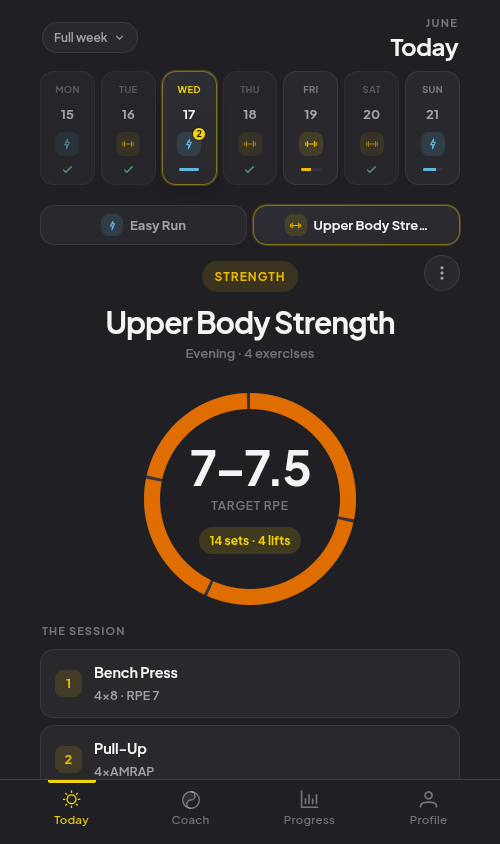
None of this is the app overruling you. Every change is a suggestion you confirm, or don't. The skill in hybrid training isn't grinding through a rigid plan or scrapping it the first time life gets in the way — it's adjusting the load around what really happened and moving on. That's the part a plan should help with, and until recently mine didn't.
If you want to see where you stand before you start, the Hybrid Athlete Score is free and takes about 30 seconds. And if you already train this way, give it a week — the plan earns its keep on the days that don't go to plan.
Two disciplines. One body.
HybridX is an AI training planner that fits both into one week.
Start free14 days free · no card
Or get your hybrid score first